Florida Greenbelt (Ag Exemption) and Your Tractor: What Landowners Should Know
Florida’s “Greenbelt” law is agricultural classification under section 193.461, Florida Statutes. If your county property appraiser classifies your land as agricultural, its assessment is based only on its agricultural use, not its market value, which can cut the tax bill sharply on rural land near growing towns. Owning a tractor doesn’t qualify land for it. What qualifies is a good-faith commercial agricultural use, and the tractor is one of the ways that work gets done. The farm-equipment sales tax exemption is a separate law with its own paperwork. This page covers both. It is general information, not legal or tax advice; your property appraiser decides classification, and a CPA or attorney should check your specific situation.
What agricultural classification actually is
Each year the property appraiser classifies land in the county as agricultural or non-agricultural. To qualify, land must be used primarily for “bona fide agricultural purposes,” which the statute defines as “good faith commercial agricultural use of the land.” Agricultural purposes include horticulture, floriculture, viticulture, forestry, dairy, livestock, poultry, bee, aquaculture, algaculture, sod farming and other farm production. Raising fish counts only if the land is used principally for tropical fish.
A few points the statute settles that people often get wrong:
- There’s no minimum acreage. The appraiser may consider whether the size of the land suits the specific use, but may not require a minimum.
- Having a house on the property doesn’t by itself bar classification. The residence and the land around it are assessed separately, and the rest can still be classified agricultural.
- Listing the land for sale isn’t, on its own, a reason for denial, as long as it stays in agricultural use while it’s on the market.
- Once classified, land keeps its status until the use changes or the appraiser reclassifies it, and a county can vote to waive annual reapplications.
Deadlines and the application
You apply on Form DR-482, the Application and Return for Agricultural Classification of Lands, filed with your county property appraiser on or before March 1. Missing March 1 waives the classification for that year, with one escape hatch: you can still file within 25 days after the appraiser mails your assessment notice, and the appraiser may grant it if you show you couldn’t file on time or had other extenuating circumstances. If not, you can petition the value adjustment board within the same window, for a $15 fee. Denials must be sent in writing by July 1 and must explain how to appeal.
The DR-482 itself asks for the type of agricultural use with acreage and years in use (citrus, cropland, grazing with the number of livestock, timber, bees and others), your agricultural income and expenses for the past four years, the purchase date and price, whether the land is leased (with a copy of the lease), and whether you’ve filed a tangible personal property return for machinery and equipment. That last question is where your tractor shows up on paper; more on it below.
What the appraiser weighs
Section 193.461(3)(b) lists the factors the appraiser may consider: how long the land has been in agricultural use, whether the use has been continuous, the purchase price, the size relative to the use, whether the land has been cared for under accepted practices such as fertilizing, liming, tilling, mowing and reforesting, and whether it’s leased and on what terms.
Counties set out their own evidence requirements. Manatee County’s application packet is a good example of what to expect. It asks for one of three kinds of financial proof: recent sales receipts for the agricultural product, CPA-audited financial statements, or a filed federal Schedule F. It says plainly that expense receipts on their own are not supporting documents. A lease must cover the January 1 assessment date, an operation at a loss or breakeven needs a business plan, and the packet notes that a few cows kept for personal use don’t qualify. Call your own county’s property appraiser before you buy anything; requirements and interpretation vary.
Where the tractor fits
The statute doesn’t mention tractors. Equipment appears only in the assessment rules for irrigation pumps and motors. So a tractor isn’t a requirement, and buying one won’t make a weekend hobby into a commercial operation. An earlier version of this page suggested equipment ownership is common evidence; based on the statute and county guidance, the stronger evidence is sales and the care of the land.
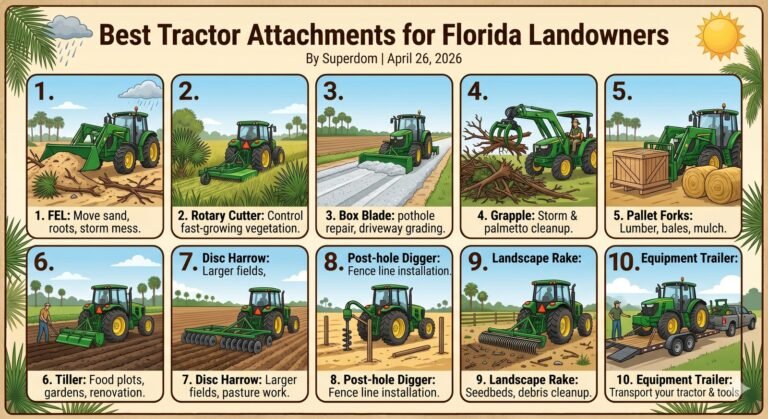
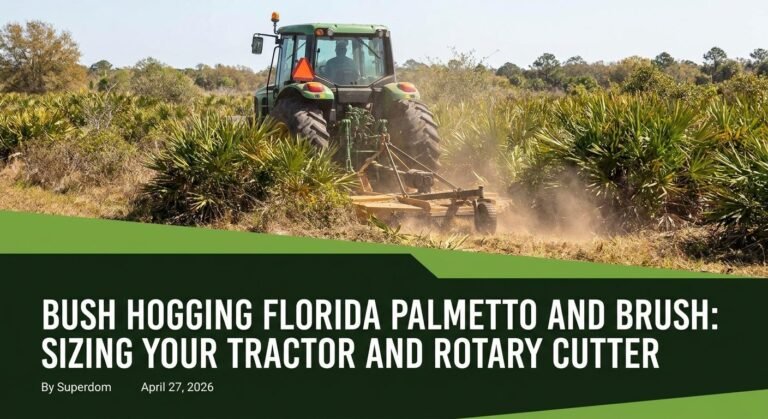
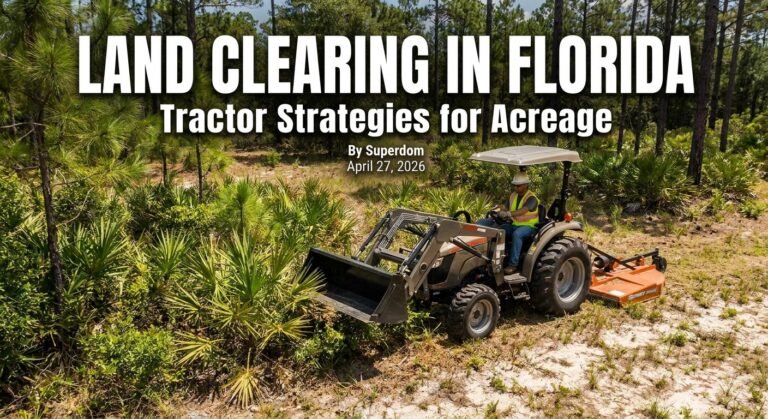
Where equipment matters is the care-of-the-land factor. A hay or cattle operation needs mowing, fertilizing, liming and weed control on a schedule, and someone has to do that work: you with your own tractor, your lessee with theirs, or a custom operator you pay. Whichever it is, keep records of when the work was done, along with the product sales that prove the operation is commercial. If you’ll be doing it yourself, size the machine to the job; our guide to what size tractor your acreage needs and the pasture renovation guide cover the equipment side.
Then there’s the property tax on the tractor itself. The Department of Revenue says owners of tangible personal property who operate a business, including a sole proprietorship, must file a DR-405 return with the property appraiser by April 1. Filing on time makes you eligible for an exemption of up to $25,000 of assessed value, and if your equipment stays at or below that, you may qualify for a waiver from filing in later years. Because the DR-482 asks whether you’ve filed a DR-405, treat the two forms as a pair if you’re running the land as a farm business.
The sales tax exemption on farm equipment
An earlier version of this page called this a “TIP-established exemption,” which was wrong. TIPs are the Department of Revenue’s Tax Information Publications; they explain the law but don’t create it. The exemption is in the statute, at section 212.08(3), Florida Statutes:
- Power farm equipment and irrigation equipment, including replacement parts and accessories, are exempt when used exclusively on a farm or in a forest in the agricultural production of crops or products, or for related fire prevention and suppression.
- The exemption covers the sale, rental, lease, use, repair and storage of that equipment. Moving it from one farm to another doesn’t forfeit the exemption.
- A farmer’s trailer used exclusively for agricultural production, or for hauling farm products to the point of sale, is exempt on purchase. Trailer leases and rentals are not.
- To claim any of these, the buyer, renter or lessee signs a certificate stating the equipment will be used exclusively as the law requires. The dealer who holds that certificate isn’t liable for the tax; if the claim was improper, the state looks to the buyer.
A separate paragraph, 212.08(5)(a), exempts other agricultural items, again with a signed certificate: fertilizers and pesticides, seeds and plants, and fencing on agricultural land, among others. FDACS’s agricultural sales tax flyer groups the categories in plain language.
The amount is real. Florida’s state sales tax is 6%, so on a $40,000 tractor the state portion alone is $2,400, before any county surtax.
The Farm TEAM Card: where the two laws meet
Since January 1, 2024, qualifying farmers can use the Florida Farm Tax Exempt Agricultural Materials (TEAM) Card instead of signing a certificate for every purchase. Per DOR’s TEAM Card FAQ, you apply to the Department of Revenue on Form DR-1 TEAM, and once you’re approved, FDACS issues the card. There’s no fee, you can request up to 10 cards (for a farm manager, say), and each card is good for five years. To be eligible you must be a farmer whose land is classified agricultural under s. 193.461, or who has implemented FDACS-adopted agricultural best management practices on land you own or lease. That’s the link to Greenbelt: classification is one of the two routes to the card.
The card is optional. DOR’s guidance for sellers, TIP 24A01-01, says farmers may still give a paper exemption certificate, which must include the buyer’s name and address, the reason the item is exempt, and a signature. A dealer accepting the card keeps a copy, or can get an authorization number from DOR instead, and isn’t liable for tax on sales made in good faith.
The same warning applies either way. “Exclusively” is the operative word. A tractor that mostly mows a homestead lawn, or splits its time between the farm and a side business, doesn’t fit the exemption, and a wrongly claimed exemption becomes the buyer’s tax bill later.
A sensible order for a new rural landowner
- Call your county property appraiser’s agricultural section and ask what they need to see for the use you have in mind.
- Decide whether you’ll run the operation yourself, lease the land to a cattle or hay operator, or hire custom work. That decides whether you need a tractor at all.
- If you will be buying, size the machine to the work, then price it with the sales tax exemption in mind. Our compact tractor price guide has current list prices.
- Have your certificate or TEAM Card ready before the purchase is written up, not after.
- For implements you’ll use once or twice a year, consider renting rather than buying.
When you’re ready to buy, the dealer map shows every equipment seller in our directory, or browse the Florida tractor dealer directory by region. The financing guide covers how farm and captive financing compare. This page is general information, not legal or tax advice.